Back in my day, you had to really WORK if you wanted to read Miracleman (or Marvelman if you’re nasty!). This comic was the lost work of Alan Moore (aside from, you know, the actual lost work of something like Big Numbers with Bill Sienkiewicz… but that’s another story!), horribly entangled in legal battles and badly out of print collected editions. If you wanted to read Moore and artist Gary Leach’s superhero subversion, you had to dig, man. Both ways! In the snow!
Then Marvel Comics found a loophole to acquire the license to Miracleman in the 2010s (Disney money/lawyers rise up!), and suddenly the long lost comics classic was not so lost. Even with the wrinkle that Alan Moore has long since distanced himself from corporate reprints of his licensed works (in probably the weirdest credits fact in comics, Marvel has to refer to Moore as ‘The Original Writer’), now you can pretty easily collect the entire Miracleman saga. Kids these days! They’ll never learn the value of a dusty old longbox at a comic con!
Related Reading Orders:
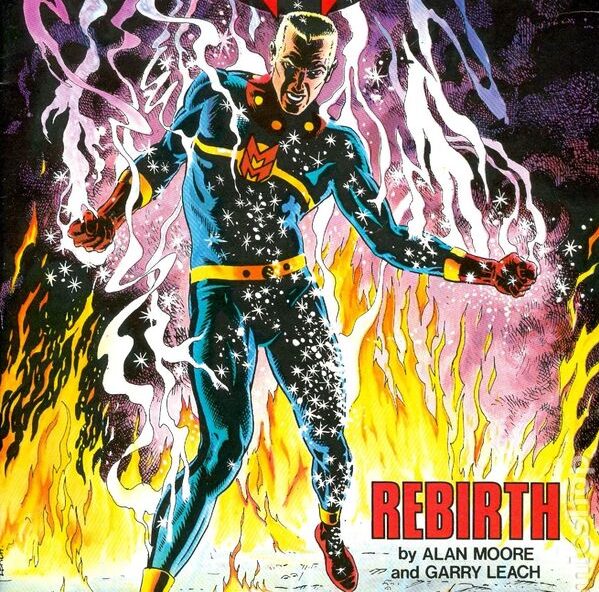
In addition to simply recommending the read to those who haven’t experienced Miracleman before (seriously, the book’s impact can be felt as strongly as Watchmen throughout the 2000’s; arguably more so), here are some facts and curios I enjoyed learning while researching the work for a discussion on the Extra Issues Podcast:
1) Miracleman has what might be the most complicated legal history in comics, basically covering the superhero medium from Superman to today. There are quite literally entire books written on the subject, such as Poisoned Chalice (which you can also read over on The Beat). In addition to the better known ties to Marvel and DC (the series launched originally as Marvelman to continue in the vein of the very popular Captain Marvel after DC’s legal harassment forced Fawcett’s doors to shut in 1954; The book had to change from Marvelman to Miracleman in the 1980s to avoid Marvel Comics litigation!), I learned how Neil Gaiman (Sandman) and Todd McFarlane’s (Spawn) ongoing legal feuds also involved Miracleman!
Gaiman and McFarlane had a series of copyright lawsuits through the 90s and aughts, including McFarlane buying the rights to Miracleman for $25,000 in 1996, with Gaiman (as the chosen heir apparent on the series by Moore himself) challenging that. What I did not know, was that Gaiman took on writing Marvel 1602 in part to fund the ongoing legal battle! In the intro to a trade for Marvel 1602 Neil writes “To Todd, for making this necessary”!! Miracleman strikes again!
2) Marvel’s 2022 Miracleman Omnibus includes a “lost” Grant Morrison written script illustrated by Joe Quesada (originally published for the first time in 2014’s All-New Miracleman Annual #1 after Marvel Comics acquired the rights in 2009… ish). What I didn’t realize was Morrison was actually asked to take on Miracleman after Alan Moore… but Moore shut him right the hell down! You can watch Morrison’s telling of events right here from the Talking With Gods documentary.
3) The thing that captivated me the most on this reread was wondering where Moore’s approach to Miracleman falls historically in the superhero genre. Put simply: Is this actually the first, or at least first major work that approached superheroes in this particular way, with the serious, poetic treatment of superheroes in “real life.”
In some ways, the answer does appear to be “Pretty much, yeah!” but there are some notable influences that Moore and others have discussed.
- Superfolks – The Robert Mayer novel from 1977 is the most controversial influence, primarily because Grant Morrison has spent decades needling Moore by suggesting he ripped off Superfolks in Miracleman, Watchmen, and Whatever Happened to the Man of Tomorrow? I won’t litigate the degrees of influence, but in its parody, there are unquestionably seeds Moore also plays with.
- Superduperman – The Harvey Kurtzman and Wally Wood parody of Superman from MAD magazine (in 1953) was one of the most famous comics I’d never read, and I’m happy to say, you can check it all out! This was acknowledged by Moore as a major childhood influence, from the time he was 11 thinking it’d be funny if Captain Marvel forgot his magic word.
- Man of Steel, Woman of Kleenex – Larry Niven’s 1969 essay dares to ask what if a grown man obsessed over Superman’s sperm. I don’t think it’s worth reading, but it certainly made an impact, and does reflect the sensibility of taking these superhero comics very, very (way too) seriously.
- “Where are You Now Batman” (Poem by Brian Patten) – This is another one Moore has referenced, a poem playing with the idea of our heroes of myth growing old.
Of course the common denominator among all these is that none of them are ongoing comics (and in fact, “Superduperman” is the only actual comic of the bunch). Regardless of the similarities you can find in the influence, I don’t think there’s any real debate that Moore and Leach’s approach to Miracleman transforms those seeds into something altogether transcendent.
Again, there’s a reason it’s shaped superhero comics for the past 40 years!
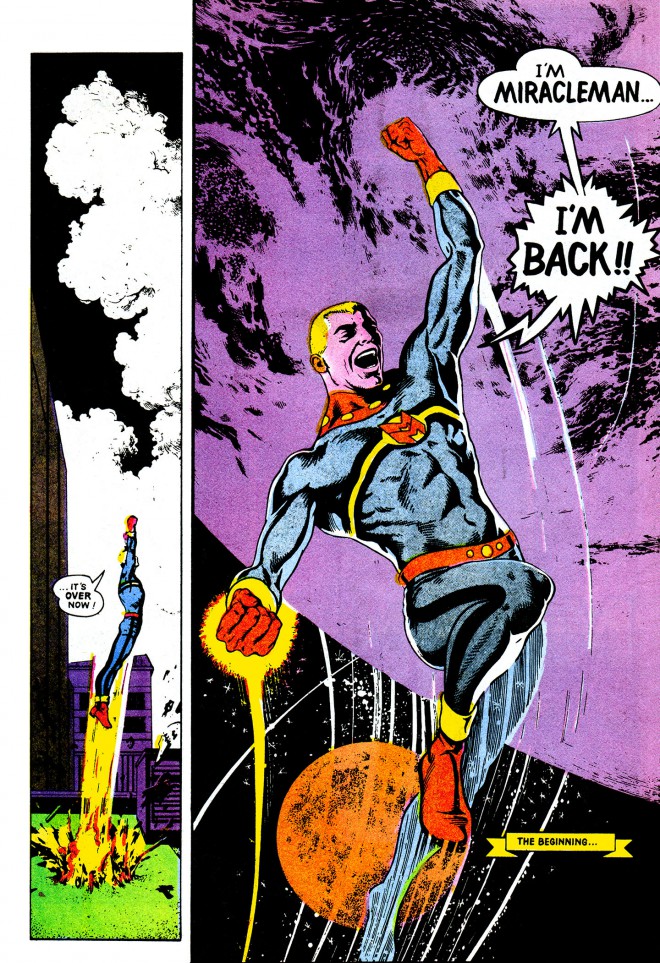
The Miracleman Graphic Novel Reading Order
Collects: Miracleman (1985) #1, #3 and #6-16; Miracleman Special #1 and material from A1 (1989) #1 and Warrior #1-18 and #20-21, All-New Miracleman Annual #1
Marvel’s 2022 Miracleman omnibus includes around 400 pages of comics, and 400 pages of extras, including the entire original run by Alan Moore, Garry Leach, Alan Davis, and John Totleben, with coloring from Steve Oliff.
Since Marvel reprinted the entire run in – an admittedly clearer – 2014 recolored Miracleman, they list the original run here as Miracleman (2014) #1 to #16. Don’t worry, despite the modern year, these are the same story from the original 80s run. In addition to the original works, the omnibus also includes two stories from Marvel’s All-New Miracleman Annual #1 (2014) from Grant Morrison/Joe Quesada and Peter Millgan/Michael Allred.
Miracleman Vol. 1: A Dream Of Flying
Collects: Miracleman (2014) #1-4
The equivalent of the Miracleman chapters of Warrior (1982-84) #1 to #8, with the first issue debuting in 1982.
Miracleman Vol. 2: The Red King Syndrome
Collects: Miracleman (2014) #5-10
The remaining Warrior chapters before the publisher closed and the series was picked up by Eclipse Comics.
Collects: Miracleman (2014) #11-16, All-New Miracleman Annual #1
The third and final arc of Moore and company’s Miracleman. The last issue was released in late 1989.
Kimota! The Miracleman Companion
Collects: Exclusive interviews with Alan Moore, Neil Gaiman, Mick Anglo, John Totleben, Mark Buckingham, Barry Windsor-Smith, Rick Veitch, Garry Leach, Alan Davis, Chuck Austen, Dez Skinn, Cat Yronwode, and Beau Smith; the previously unpublished 8-page Miracleman short story “Lux Brevis” by Alan Moore and John Totleben; a never-before-published Alan Moore Miracleman script; Moore’s original pitch to Dez Skinn; Moore’s first script for the original Marvelman story from Warrior magazine; unseen artwork from the unpublished Miracleman #25; sketches and concept art by Totleben, Windsor-Smith, Buckingham, Mike Deodato, Jim Lee, Todd McFarlane, and others; a complete Eclipse Comics American cover gallery; an introduction and back cover art by Alex Ross; and a front cover by Mark Buckingham.
For the history buffs!
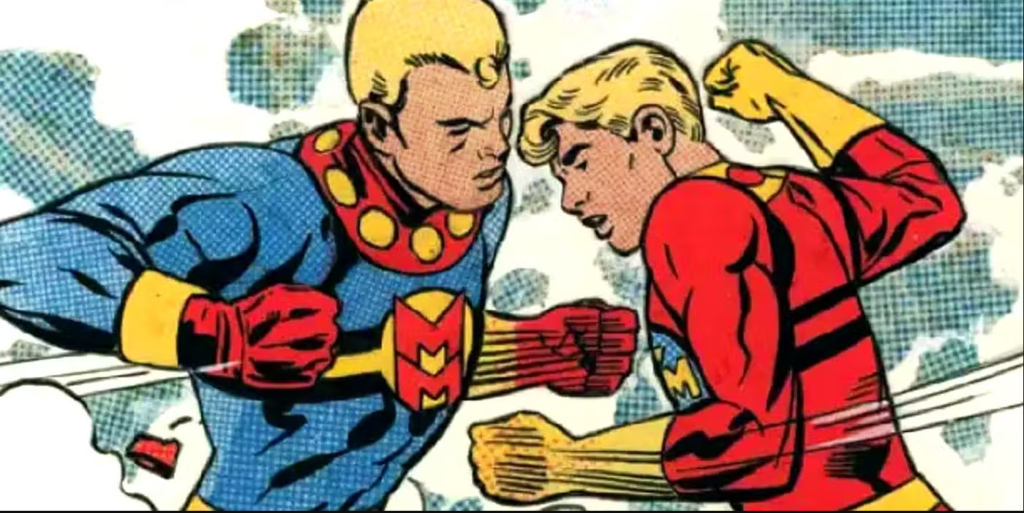
Miracleman By Gaiman & Buckingham: The Golden Age
Collects: Miracleman (1985) #17-22 and material from Total Eclipse #4 [reprinted in Miracleman By Gaiman & Buckingham #1-6]
Moore’s run is followed – fairly promptly – in 1990 by Neil Gaiman and Mark Buckingham in “The Golden Age,” the first of three planned ages. Eclipse folded following the publication of “The Golden Age” and the run was never continued until the Marvel revival of the 2020s.
Collects: Miracleman: Apocrypha #1-3.
Collects: Miracleman (2022) #0
Marvel’s first collection of entirely new Miracleman stories, and the first (near only) comic included in Marvel Unlimited (I’m guessing the “mature” rating of the original series is what’s keeping the 2014 reprints out of the service). This teases the return of Gaiman and Buckingham’s Miracleman as well as some possibilities for the character’s future in the Marvel Universe.
Miracleman By Gaiman & Buckingham: The Silver Age
Collects: Miracleman By Gaiman & Buckingham: The Silver Age #1-7
Marvel’s most respectful move with the Miracleman license comes in the form of allowing Gaiman and Buckingham to continue their long dormant Miracleman run, which fairly successfully picked back up with “The Silver Age” from 2022 to 2024.
Ironically – disgustingly – the planned “Dark Age” will likely never see the light of day following the incredibly dark allegations of abusive conduct by Neil Gaiman.
Marvel Comics #1000
Collects: A one-page Miracleman story by Neil Gaiman and Mark Buckingham (the “2014” page), featuring Miracleman reflecting on his world’s history while reading a copy of Marvel Comics #1. This is basically just a big ol’ tease that A) Marvel’s got Miracleman now B) They may just jam him into Earth-616!
Timeless (2021) #1
Collects: Miracleman does not appear directly in this issue, but the final page features a teaser drawing of his iconic double-M chest emblem, marking Marvel’s official announcement of the character’s eventual integration into the mainline Marvel Universe. There was even a massively Watchmen-coded teaser (a clock striking 6:16) that went untouched for 5 years until…
Ok, buckle up.
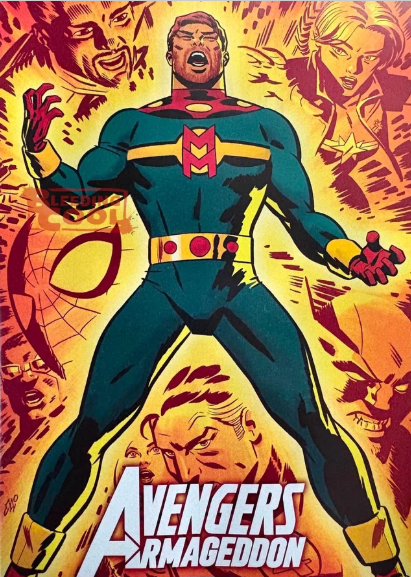
Here’s the shortest possible version: During Marvel’s 2026 event Avengers: Armageddon, a new character from Chip Zdarsky’s Captain America run, David Colton, was granted the powers of Miracleman. There’s a new Miracleman in Marvel Comics! Ok! Easy! End of conversation!
Except, uh, let’s unpack this.
Instead of any of the preceding teases of Miracleman (Michael Moran) observing and entering Earth-616, Marvel is instead opting for the following approach: David Colton – again, a brand new super soldier, basically what if one of the many disillusioned would-be Captain America’s had a reddish beard – obtains the powers of Miracleman via an origin box from the Maker via Marvel’s new Ultimate Universe. So in theory, you’d need the full CBH Armageddon event reading order to understand every nook and cranny of context here, which spans the Ultimate 2niverse, and writer Chip Zdarsky’s work building up to a new Avengers team.
Never let it be said that Marvel doesn’t make weird choices!
Or – keep calm and enjoy the comics! It’s worked before! Kimota!

Leave a Reply