This month, I dig into my thoughts on the Eisner-Winning Assorted Crisis Events, try to become a Trekkie, and find at least two new graphic novels worthy of the annual list (including one frontrunner!).
To get these picks sent directly to your mailbox every month, sign up here for free.
To see the full year’s list, check out the best comics of 2026 (updated monthly!).
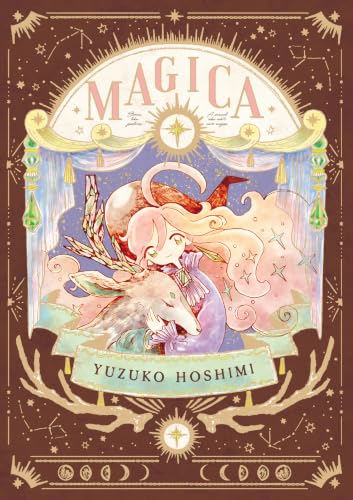
If you like gorgeous fairytales with basically no limits on the sci-fi fantasy worlds they can occupy, boy do I have the manga for you! Magica by Yuzuko Hoshimi is a series of seemingly disconnected stories told in a world of magic, evoking classic fairy tale structure while completely unimpeded by the conventions of those who’ve come before. The Josei manga (I think I’m using that right? I’m just a noob!) recalls the whimsy of Jill Thompson’s Scary Godmother, told through similarly striking illustration. Magica’s like what if Peach Momoko wanted to write the most popular book existing within the universe of Witch Hat Atelier.
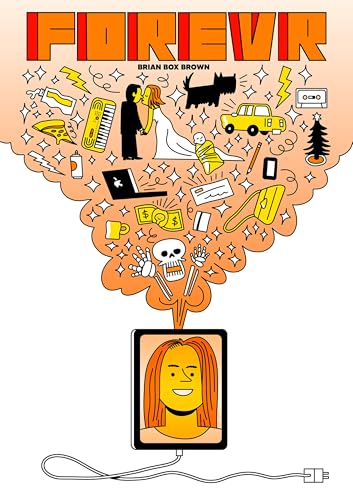
Brian ‘Box’ Brown is critically acclaimed and respected for his brand of pop culture histories (subjects include Andre the Giant, Tetris, and He-Man), but with Forevr via Top Shelf, Brown moves into the realm of purely fictional slice of life sci-fi. Forevr is a lighter-hearted Black Mirror glimpse into the future (and a future that feels more like 15 months away instead of 15 years!), where AI versions of the deceased are on the rise to help loved ones cope with their loss.
Brown’s cartooning is well suited for the shift in modes, effectively and efficiently selling the driving characterizations of the focal family, as the group’s matriarch is diagnosed with terminal cancer. At its best, Forevr feels deeply of the moment, considering the ways corporations might monetize the ability to use artificial intelligence to manipulate the grieving. Brown’s more satirical than scathing – although certainly the ideas aren’t mutually exclusive – and the ending feels strangely torn between absurdity and pathos. Like an AI of your lost loves yelling “FREE ME,” Forevr never quite clicks in that “OH CRAP” way the best of Black Mirror can, but it’s a compelling graphic novel throughout. I hope Brown continues in this vein as it’s a great use of his obvious talent.
Star Trek: The Last Starship Vol. 1
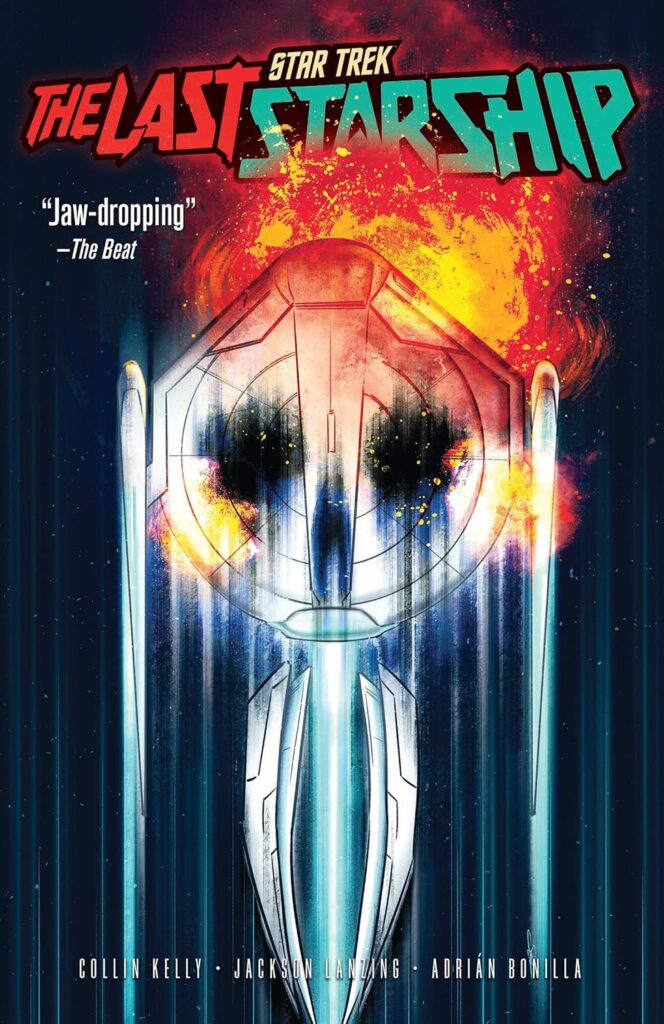
I can get pretty in my head about what qualifies for one of the best comics of the year, or of a monthly post, but sometimes, I just have to quiet that noise and answer a pretty simple question: Do I want to keep reading? With “The Last Starship” from the writing-partners Kelly and Lanzing and artist Adrian Bonilla, the answer is remarkably simple. Yes. I absolutely want to turn the page and see where they take Star Trek next.
Please note that spoilers for the first issue will follow – go read the very good comic if you don’t want to know anything beforehand!
I’m not a certified Trekkie, so forgive any inaccuracies here, but “The Last Starship” feels a lot like a version of “The Dark Knight Returns” or “The Last Ronin” set in a future where the United Federation of Planets stands on the brink of collapse. In order to prevent the complete dissolution of the peaceful organization they’ve spent centuries cultivating. the remaining Starfleet decision makers team up with the remnants of The Borg, and the resurrected simulacrum of Captain James T. Kirk (I don’t feel especially guilty revealing this detail, as its heavily advertised within the book’s own solicits, and via some awesome Franceso Francavilla covers). It’s a comic that wastes no time escalating to Star Trek Doomsday scenarios, and feels both rooted deep in the decades of franchise lore, and instantly accessible to tourists like myself who know just enough to have my eyes dilate when I see the names Kirk, Borg, and Klingon.
The Kirk of it all is the most interesting decision by the creative team. On one hand, centering the work around the hero mythology of William Shatner’s 60s original more or less ensures that the remainder of the very compelling crew gets lost in the shuffle. At the same time, it’s also exactly the kind of hook fully pulled me into the vision, and has me thinking about giving a copy to my Dad for Christmas. I’m very interested in volume two, and how Kelly, Lanzing and Bonilla might see the “Last Starship” safely home to port.
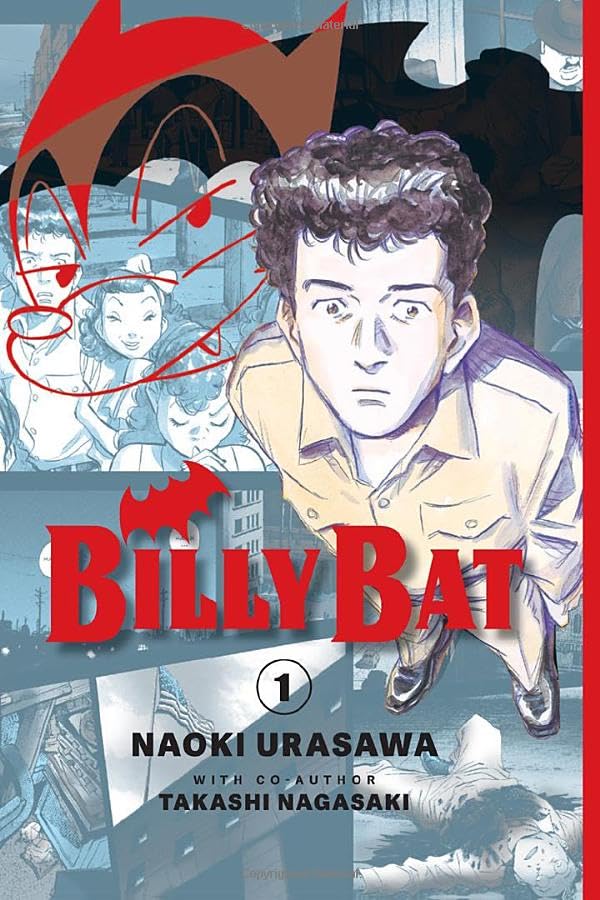
You know, I’d be a lot more into Billy Bat if I hadn’t also read 20th Century Boys earlier this year. Much ado was made about Abrams finally putting out an English translation of Billy Bat by Naoki Urasawa and Takashi Nagasaki, to the point that I assumed perhaps this was one of Urasawa’s earliest works from the long ago forgotten age of the 1980s! But nope, Billy Bat began shortly after 20th Century Boys (1999–2006) concluded, and towards the tail-end of Pluto (2003–2009), running from 2008 to 2016. A full decade later, Abrams Comics has obtained the license for these English translations, and given Urasawa is my first favorite Mangaka, obviously I’m picking up the releases with great expectations.
Like any Urasawa, Billy Bat is addictive storytelling. I’m yet to experience a mangaka who comes close to Urasawa at wholly and completely absorbing you into the mystery of their work. As I alluded to, though, the first volume and a half are deeply reminiscent of the same tricks and techniques found in 20th Century Boys (and to a lesser extent, Uraswa’s current ongoing manga, Asadora!). The premise is substantial – Billy Bat is a “Mickey Mouse” type cartoon figure that an American cartoonist realizes he may have accidentally plagiarized from a Mangaka in Japan. The mystery of Billy Bat’s origins quickly spirals out of control to far deeper and more nefarious beginnings. Nonetheless, having poured after page after page of 20th Century Boy’s “The Friend” reveal, I found myself far less eager to fall into another one of Urasawa’s enigma machines.
Volume two completely suckered me back in with out of left field historical excursions that include the – and I’m dead serious here – unlikely role of Billy Bat’s impact on Judas Iscariot in the betrayal of Jesus Christ. Imagine Judas, fresh off the crucifixion, getting chastised by a cartoon bat, but played totally straight, and you’re well on your way to the audacity of this work!
I’m reading the whole series! I don’t care how similar it is to the rest of Urasawa’s oeuvre! Billy Bat Forever!
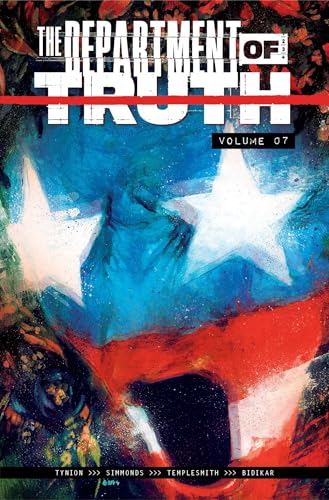
The Department of Truth Vol. 7
There’s a reason The Department of Truth came in #4 on my 10 favorite Image ongoing runs of the 2020s, and remains one of my favorite contemporary ongoing series. Oddly, as the James Tynion IV and Martin Simmonds book progresses, that reason has less and less to do with the actual core! Volume 7 – issues #0 and #34 to #38 – helps crystalize the two modes of DoT, with a first half continuing the present day efforts of Lee Harvey Oswald and Cole Turner to put their stamp on “truth,” and a second half of ‘Deviations’ doing my preferred work: Weirdo conspiracies come to life (Dinosaurs at a Florida evangelical theme park! Elvis in your pelvis!).
It’s a victory lap stretch for the Tynion IV verse, with new volumes of Exquisite Corpses and WorldTr33 out around the same time, and although I’m very much along for the ride on the whole Tiny Onion experience, the proximity helps clarify that I’m absolutely, still, the most excited about The Department of Truth. I don’t know that it all works, but I remain enamored with Tynion and Simmonds willingness to run headfirst at the contemporary political climate, even if ultimately it’s not like they have any more of a salve for what ails us than any other comic book. But still – they’re running towards the danger, and even if they trip and fall into a pool of their own blood, I have to find out!
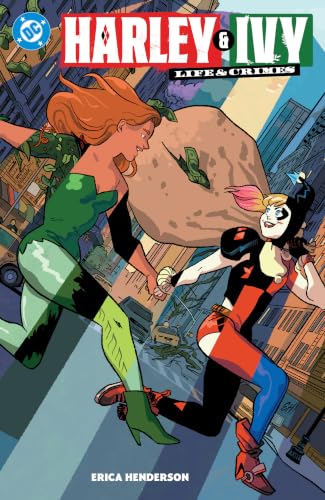
Harley & Ivy: The Life and Crimes
It is rare – exceedingly rare – that I can hopescroll through Marvel Unlimited or DC Universe Infinite and find an exciting new comic or graphic novel that I straight up did not know about (hopescrolling is my process of eagerly – some would say ravenously – searching through new releases on comics streaming apps and hoping I find my next favorite read, even though I already have 49 review downloads sitting on my tablet just sitting there appalled at my lack of focus!). Yet, in the case of Harley and Ivy: Life and Crimes by Erica Henderson that’s exactly what happened. I had no idea Henderson (Unbeatable Squirrel Girl, Dracula, Motherf**ker) was cartooning her own definitive origin of Poison Ivy and Harley Quinn, yet am delighted to report not only does it exist, but it rules!
The Life and Crimes feels like it should be a DC Black Label book – and has quite a bit of meta fun with the fact that it’s not – in that Henderson is the sole creator in a work that feels both canonical and atemporal (Henderson has a LOT of fun here with the Joker’s New 52 face-cutting-off phase). As a cartoonist, Henderson’s had a really interesting post-Squirrel Girl career, showcasing an entirely unknown explosiveness in the pages of Dracula, Motherf**ker with Alex de Campi, and honing those comedic and narrative chops via continued collaborations with Kyle Starks and Ryan North (modern masters of the comedic comics artform). The Life and Crimes showcases an artist fully prepared to to ascend to the pantheon of do-it-all savants like Cliff Chiang, Daniel Warren Johnson, or E.M. Carrol.
This is a riotous, sensual, carefully built look at Harley and Ivy from a cartoonist I can’t wait to read more from.
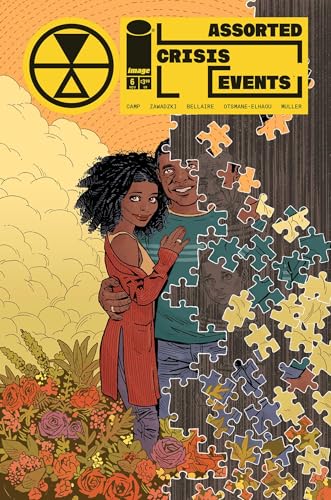
Before I start picking nits with an instant out-of-the-box Eisner Winning series, let’s focus on the bright side: Assorted Crisis Events is the best kind of marriage of creator owned ambition and popular genre. Deniz Camp, Eric Zawadzki, Jordie Bellaire, and Hassan Otsmane-Elhaou have effectively refined the premise of the “everyman” living in the chaos of a DC Crisis on Infinite Earths that hurtles forward without the slightest regard to those everyday lives. Every issue of Assorted Crisis Events is a new look at the human cost of multiversal madness, with Camp honing in on a modern parallel that reflects our reality.
I quite like living in a comics landscape where Assorted Crisis Events exists. As I noted in the volume one review, it’s the superhero-core successor to Ice Cream Man (there’s an Ice Cream shop owner in an issue here sharing the name of ICM writer W. Maxwell Prince!), and for my money, that’s *the* comic all other creator-owned works should aspire to. At its best, Assorted Crisis Events threatens “best issue of the year” with each new release. Assorted Crisis Events #6 is an unflinching, emotionally honest reflection on dementia and elder care filtered through the lens of Benjamin Button on amphetamines. When ACE goes smaller, and the “Crisis” becomes a near afterthought, it has the potential to capture some of the most affecting human stories on comic shop shelves.
I’m trying to arrive at a point of reflection where I don’t sound like a condescending ball of pretension – readers, in unison: too late! – when I say that ACE is not especially close to my favorite comic, but I quite love and understand how it could be the most impressive, interesting comic for a lot of readers, especially fresher less jaded ones! As a series, it butts heads against exactly what I hope to see from creators and a jaded sense that I’ve mostly seen all this before. Issues 8 and 9 for example either wear their influences too openly (Camp’s an obvious apple from the Morrison coaching tree, but ACE #8 might owe Flex Mentallo royalties) or simply miss a resonant take on the issue (ACE #9 simply arrives at a time when the new graphic novel GIGS is running laps around the same idea).
But really, all this is critical analysis only interests me because it’s fueled by thoughtful, interesting comics made by extraordinarily talented people. I won’t miss a single issue of Assorted Crisis Events, and you probably won’t want to either!
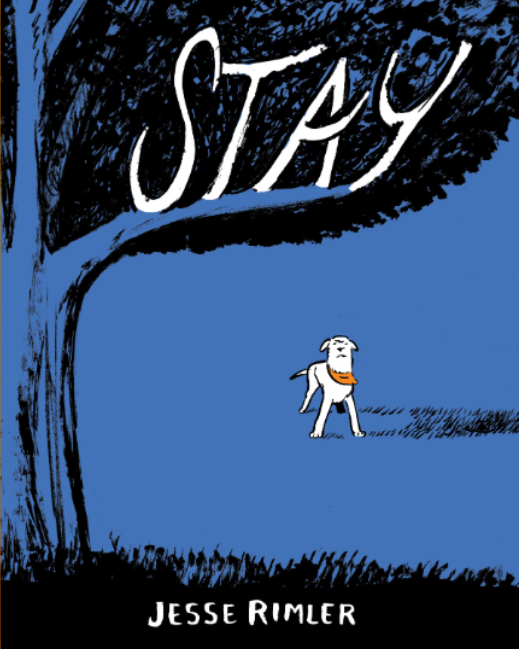
Stay
On the back of Stay by Jesse Rimler, there’s a pull quote from Chester Brown (Paying For It, Louis Riel) in which he – affirmingly – refers to the work as “elegant, straightforward storytelling.” As reviews go, it’s hardly a rave, but it effectively captures the appeal of Rimler’s work, which feels both decidedly familiar yet extremely well told. This is a story about an alcoholic woman trying to pet-sit her sister’s dog for a weekend without A) Bailing B) Getting hammered or C) Getting hammered and bailing.
Part of Fieldmouse Press’s Spring 2026 catalog (among my favorite semi-annual traditions in comics publishing), Rimler’s graphic novel debut is confident, affective, and darkly funny. There are shades of David Aja’s Pizza Dog in the representation of Stay’s increasingly communicative pup, easily one of the best dogs in comics this year.
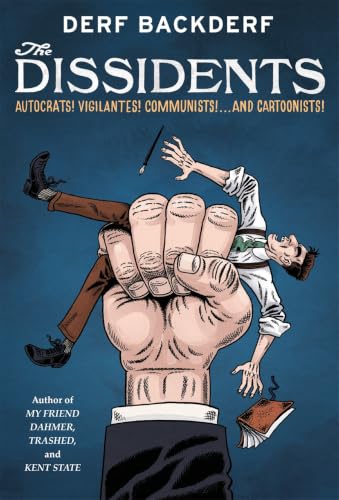
The Dissidents: Autocrats! Vigilantes! Communists! And Cartoonists!
I’d imagine he wants no part of his, but Derf Backderf is making a run at American Splendor’s Harvey Pekar for cartoonist I most strongly associate with American history in Cleveland, Ohio. Hot on the heels of his masterwork on the history of the Kent State shootings, Backderf returns with his most exhaustively researched graphic novel yet, The Dissidents via Abrams ComicsArts.
The timeliness and modern parallels of this story set 100 years ago is the most obvious thing about The Dissidents, but it’s also the most striking and most harrowing. Backderf’s fictionalized history (the players and events are real, and deeply researched, but of course the nooks and crannies of narrative are educated reconstruction) begins in 1916 with America under the thumb of President Woodrow Wilson and involvement in World War I on the horizon. Backderf presents this landscape through the lens of fictional German immigrant Joe Hertle, an aspiring cartoonist particularly enamored with the fearless political cartoons published via The Masses magazine.
The work doubles then as a history of America from 1916 to 1920, and of the power and position of the political cartoon. Backderf merges his own confident largely black-and-white storytelling with scans of the actual cartoons from the likes of Art Young or Robert Minor, providing key context into the actual historical existence of The Masses and their contributors.
It’s a gripping, tense history of persecuted immigrants used to foment frothing rage for political gain, and of an administration hellbent on organized thugs threatening the very notion of free speech. It’s “What if ‘History repeats itself'” was one of the best graphic novels of the year?

Leave a Reply